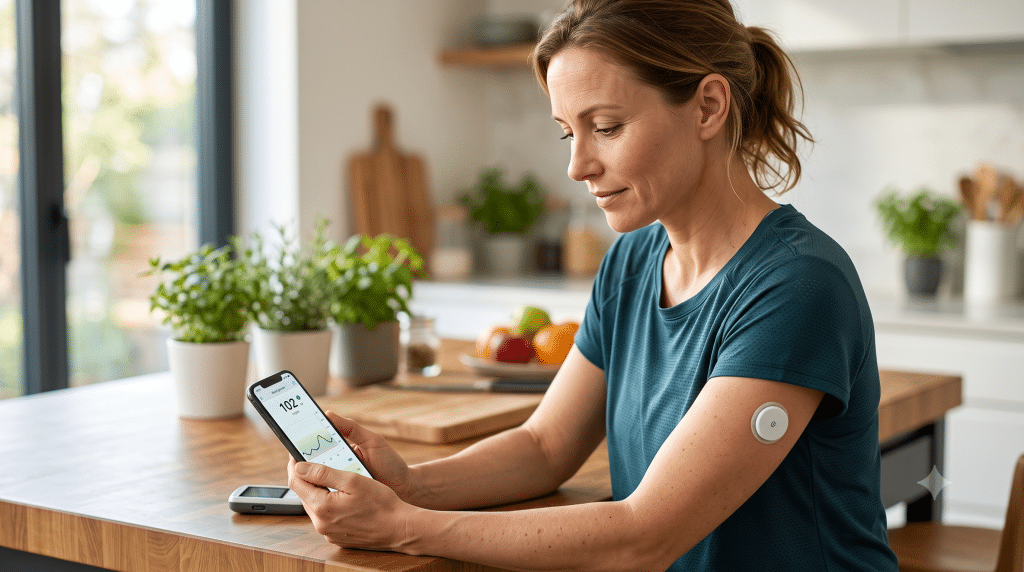
Continuous glucose monitors, or CGMs, were once used almost exclusively by people living with diabetes. Today they are sold over the counter and marketed to healthy people as a tool for weight loss, energy, and disease prevention. This has left many people asking a reasonable question: if you do not have diabetes, is wearing a CGM actually beneficial, or is it mostly hype?
This article explains what CGMs do, reviews what the current evidence shows for people without diabetes, outlines the potential risks, and describes evidence-based ways to monitor your metabolic health.
What Is a Continuous Glucose Monitor (CGM)?
A continuous glucose monitor is a small wearable sensor that measures glucose, the sugar your body uses for energy, in the fluid just beneath your skin. A thin filament sits under the surface, usually on the upper arm or abdomen, and records glucose levels every few minutes. Those readings are sent to a smartphone app or a small receiver, giving a continuous picture of how blood glucose changes throughout the day.
For people with diabetes, particularly those who use insulin, CGMs are well established and highly valuable. They reduce the risk of hypoglycemia (dangerously low blood sugar), improve overall glucose control, and help guide precise insulin dosing. The U.S. Food and Drug Administration has now cleared over-the-counter CGMs, which expanded access to people who do not have a diagnosed medical condition. To learn more about how these devices operate clinically, you can review the official NIH guide on continuous glucose monitoring.
Why Are People Without Diabetes Using Continuous Glucose Monitors?
Much of the interest comes from the broader wellness movement and the popularity of self-tracking. Many of us already monitor steps, sleep, and heart rate, so tracking blood glucose can feel like a natural extension of that habit.
CGM manufacturers and wellness platforms promote the devices as a way to see, in real time, how meals, exercise, sleep, and stress affect your blood sugar. The stated goal is to help users identify foods that cause large glucose swings and adjust their habits accordingly. This messaging is especially appealing to people focused on optimizing their health and performance.
How Blood Glucose Works in a Healthy Body
Understanding normal physiology helps put CGM readings in perspective. When you eat, your blood glucose rises, and your pancreas releases insulin to move that glucose into your cells. This after-meal rise, known as a postprandial increase, is a normal and healthy response. Carbohydrate-rich foods such as bread, fruit, and rice raise blood glucose more than other foods.
Food is not the only factor. Stress hormones, poor sleep, skipped meals, and physical activity all influence your levels as well. Over many years, frequent and significant glucose spikes can contribute to insulin resistance, type 2 diabetes, weight gain, and cardiovascular and kidney disease. A single spike after a meal, on its own, is not a sign of disease. To better understand how your endocrine system regulates blood sugar, you can learn more about hormone imbalances and insulin function.
What Does the Evidence Say for People Without Diabetes?
Current research on CGM use in people without diabetes is limited. To date, no large, high-quality clinical trials have shown that these devices improve health outcomes in this group.
One study of 153 participants without diabetes found that their glucose was in the normal range approximately 96 percent of the time, and many readings flagged as abnormal were later judged to be implausible or device errors. A few small studies reported that participants felt more motivated to exercise after using a CGM, though short-term motivation is not the same as a lasting health benefit.
There is another important gap. The metrics used to interpret CGM data, such as time in range and glycemic variability, have been validated for people with diabetes. There are no established reference ranges that define what is normal or concerning for people without the condition. In practical terms, this means much of the interpretation in healthy users is guesswork.
Potential Risks of Using a CGM Without Diabetes
A device that measures a real value can still cause harm when used without clinical context. Health professionals highlight several concerns.
- Misreading normal physiology. Postprandial glucose can rise above 140 mg/dL in healthy people without indicating any disease. Many consumer apps flag these values as high, which can cause needless worry.
- Anxiety and hypervigilance. Constant monitoring, and alarms for minor overnight dips, can disrupt sleep and increase stress.
- Disordered eating. Users sometimes eliminate nutritious foods such as fruit, carrots, or whole grains after seeing a spike, which can lead to overly restrictive eating patterns.
- A narrow view of health. A CGM measures only glucose. It does not account for cholesterol, triglycerides, blood pressure, or sodium intake, all of which are central to cardiometabolic health.
- False alarms and unnecessary care. Inaccurate readings may prompt avoidable testing, clinic visits, or anxiety.
- Cost. CGMs can cost hundreds to several thousand dollars per year and are typically not covered by insurance for people without diabetes.
Who May Actually Benefit From a Continuous Glucose Monitor?
For certain individuals, and ideally under the guidance of a health care provider, a CGM can offer real value. Potential candidates include people with prediabetes, obesity, polycystic ovary syndrome (PCOS), elevated cardiovascular risk, or a strong family history of diabetes.
In these groups, a CGM may reveal after-meal or overnight glucose patterns that a single fasting glucose or A1C test can miss, and the real-time feedback can support meaningful changes in diet and activity. Even here, clinicians generally recommend short-term, targeted use as a learning tool rather than continuous long-term monitoring. Wearing a sensor for a week or two is often enough to understand how your body responds to your usual routine.
Evidence-Based Ways to Assess Your Metabolic Health
For most people, the proven path to understanding metabolic risk remains standard laboratory testing. A fasting plasma glucose test and a hemoglobin A1C, which reflects your average blood sugar over roughly three months, are inexpensive, widely available, and supported by decades of research. If you have prediabetes, these tests are the reliable way to find out.
A complete picture of cardiometabolic health also includes a lipid panel, blood pressure, and a measure of waist circumference or body weight. For those taking prescribed medications or managing high blood sugar through medical supervision, understanding how medications clear excess glucose can also offer useful clinical context.
Certain findings warrant medical evaluation, including a persistently elevated fasting glucose, high random glucose readings accompanied by symptoms, or recurrent low blood sugar. If you notice these patterns, or you are unsure how to interpret your data, talk with your health care provider. For individuals exploring non-insulin options for appetite and glucose control, reviewing how injectable weight loss medications affect metabolism can provide clear guidance. You can also read about how semaglutide supports blood sugar regulation during metabolic treatment.
The Bottom Line
For most people without diabetes, current evidence does not support routine CGM use, and standard lab testing paired with healthy habits remains the foundation of good metabolic health. For selected higher-risk individuals, short-term monitoring under clinical supervision may provide useful insight. As one guiding principle in medicine reminds us, the ability to measure something does not always mean it should be measured.
Considering a CGM or Concerned About Your Blood Sugar? Talk With HEALOR
At HEALOR Primary Care in Las Vegas, our board-certified team offers evidence-based metabolic care, including on-site fasting glucose and A1C testing, and we can help you interpret CGM data if you are already using a device. Through our dedicated primary care clinic, whether your focus is comprehensive medical weight loss, energy, or preventing diabetes, we build a personalized plan around the root cause rather than a single reading. Call 702-362-2273 or book an appointment online today.